
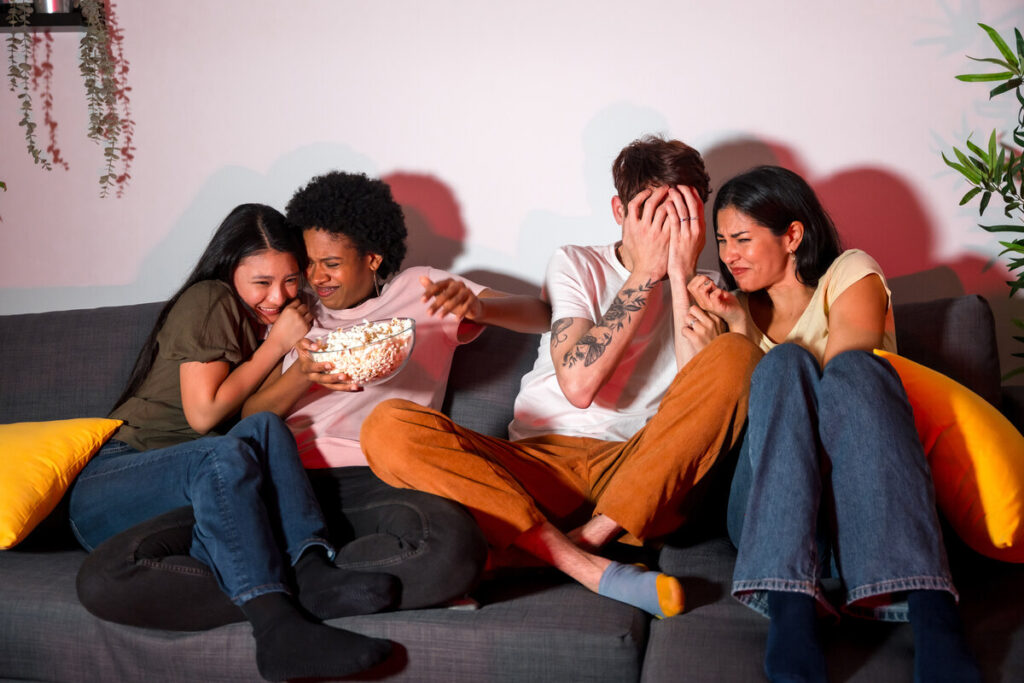
Horror movie marathons, campus haunted houses, a friend hiding behind the dorm door: for some students, being scared is a great night out. For others, it is the opposite of fun. Researchers have started measuring what happens in that gap, and the answer is less about bravery than about dose, mood and who you are with.
Your body does not know the monster is fake
When something jumps out at you, the brain’s threat system reacts first and thinks later. The amygdala, a small region involved in emotion and threat detection, helps kick off the classic fight-or-flight response: your heart speeds up, your blood pressure rises and stress hormones such as adrenaline flood your body. That system evolved to deal with predators, so it does not wait to check whether the chainsaw is real.
The difference between a real threat and a horror movie is context. You chose to be there, you know you are safe, and you know it will end. That frame is what lets some people experience a racing heart as excitement instead of panic.
Fear is most fun in the middle
One of the clearest tests comes from a field study at a working haunted-house attraction, led by researchers at Aarhus University in Denmark and published in Psychological Science in 2020. The team fitted 110 visitors, aged 12 to 57, with heart rate monitors, filmed them at the biggest scare points and asked them to rate their fear and enjoyment along the way.
Enjoyment followed an inverted U: people had the most fun at moderate levels of fear, while too little or too much fear was less enjoyable. The heart rate data told a similar story. Being frightened tracked with large swings in heart rate, while enjoyment peaked with smaller fluctuations that were, in the authors’ words, “just right.”
So a movie that feels perfect to your roommate may land far past your own sweet spot.
Some people walk out in a better mood
A team at the University of Pittsburgh surveyed 262 adults who had bought tickets to an “extreme” haunted attraction, before and after the experience, and recorded brain activity (EEG) in 100 of them. The study, published in the journal Emotion in 2019, found that participants’ reported mood improved afterward, particularly among those who said they felt tired, bored or stressed going in. Among people whose mood improved, brain reactivity to later tasks went down.
The researchers suggest that a chosen, controlled scare might help some people reset after stress. That is still a hypothesis. These were volunteers who wanted to be there, and the study does not show that a haunted house is a stress treatment.
Horror fans and resilience: a link, not proof
During the COVID-19 pandemic, an online study of 310 people, published in Personality and Individual Differences, found that horror fans reported greater psychological resilience. Fans of zombie, alien-invasion and apocalyptic films also reported feeling more prepared. The authors see this as consistent with the idea that scary fiction lets people rehearse coping in a safe setting.
But this was a correlation measured at one point in time. People who are already more resilient may simply be more drawn to horror, so watching more of it is not a proven way to become tougher.
Not enjoying it is normal too
Fear does not feel the same for everyone. A 2025 study of 1,029 visitors to a horror attraction, published in the Journal of Anxiety Disorders, found that people who struggle more with uncertainty expected and actually felt more anxiety, more negative emotions and fewer positive ones. They also tended to overestimate how bad the experience would be.
Company seems to matter as well. In a 2026 haunted house study of 347 visitors in groups, published in Emotion, visitors’ heart rates tended to sync up, and the effect was stronger between people who felt close to each other.
How to pick your Halloween scare
- Choose your dose. If big jump scares are too much, a creepy mystery or a lighter haunted trail may hit your sweet spot better.
- Go with people you trust. Shared scares feel different with friends, and it is easier to leave when you are not on your own.
- Opting out is fine. Saying no to the horror movie night is a preference, not a weakness.
- Pay attention to what lingers. If fear or anxiety keeps you from sleeping, studying or going out long after the night ends, talk to your campus counseling center. If you are in crisis, call or text 988.
The research so far points to a simple idea: being scared can be fun when it is chosen, safe and pitched at the right intensity for you.