
A cup of tea is a dorm room staple during midterms. But lab studies have found that some tea bags, especially those made with plastic mesh, release enormous numbers of tiny plastic particles into hot water. Here is what researchers actually measured, where the evidence stops, and a few easy changes if you would rather avoid the issue.
What the studies measured
The first study to get wide attention came from McGill University in 2019. Published in Environmental Science & Technology, it tested plastic tea bags made of nylon and PET (the same plastic used in many water bottles) steeped at 95°C, close to brewing temperature. A single plastic tea bag released roughly 11.6 billion microplastics and 3.1 billion nanoplastics into one cup. The authors noted that these levels were several orders of magnitude higher than plastic loads previously reported in other foods.
A newer study from the Autonomous University of Barcelona, published in Chemosphere in 2024, looked at three commercial tea bags made from polypropylene, nylon-6 and cellulose. After simulating normal tea preparation, the team counted the particles in the water:
- Polypropylene bags: about 1.2 billion nanoparticles per milliliter
- Cellulose bags: about 135 million per milliliter
- Nylon-6 bags: about 8.2 million per milliliter
So the material matters a lot, and even the cellulose bag, often marketed as a plant-based option, released particles in this test.
Can the particles get into your body
The Barcelona team went one step further. They stained the particles and exposed three types of human intestinal cells to them in the lab. After 24 hours, the cells had taken up the particles, with mucus-producing cells absorbing the most polypropylene particles.
That finding has been widely reported as plastic from tea “reaching your blood.” That is a stretch: the experiment used cells in a dish, not people, and the dose (100 micrograms per milliliter) was chosen for the lab setup, not matched to what a tea drinker actually swallows. It shows the particles can enter gut cells under test conditions. It does not show what happens in a real human body over time.
Is it actually harmful
Nobody knows yet, and that is the honest answer. The U.S. Food and Drug Administration says current scientific evidence does not demonstrate that the levels of microplastics or nanoplastics found in foods pose a risk to human health, while adding that more research is needed.
Some human data have raised concern. A 2024 study in the New England Journal of Medicine followed 257 adults who had surgery to remove plaque from a neck artery. Those whose plaque contained micro and nanoplastics had a higher rate of heart attack, stroke or death over about 34 months. But that study was observational: it shows an association, not that plastic caused the problems, and it involved older patients with existing artery disease, not college students. It also says nothing about tea specifically.
The McGill team did run a toxicity test, but on tiny water fleas, not humans. The particles released by the tea bags caused behavioral and developmental effects that increased with the dose.
Easy swaps if you want to cut your exposure
None of this means you need to give up tea. But if you want to lower your exposure while the science catches up, a few simple habits help:
- Try loose-leaf tea with a stainless steel infuser or a small strainer. No bag, no bag particles.
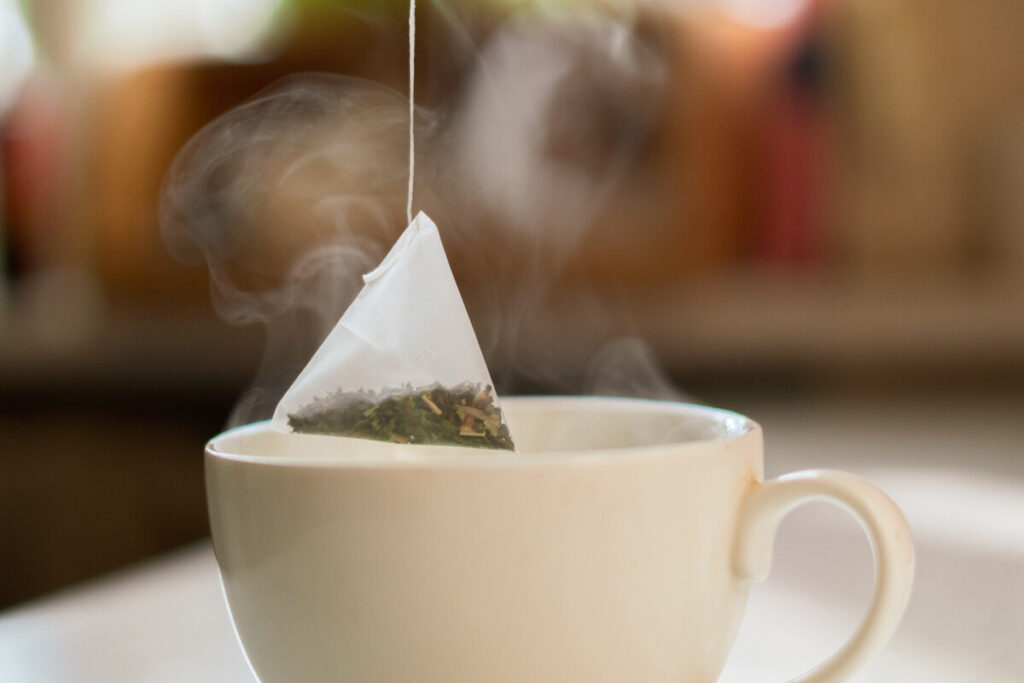
- Check the packaging. Silky, see-through “pyramid” bags are often nylon or PET mesh. If the box does not say what the bag is made of, the brand’s website sometimes does.
- Do not judge by “plant-based” alone. In the Barcelona test, cellulose bags released fewer particles than polypropylene but still released some.
Microplastics also come from many other sources, including packaging and household dust, so swapping your tea bag will not remove them from your life. It is one small, low-cost choice among many.
The bottom line
Lab studies agree that hot water pulls a huge number of tiny particles out of some tea bags, especially plastic ones. Whether those particles harm your health at real-world levels is still an open question. If you have a specific health concern, your campus health center is a good place to start.