
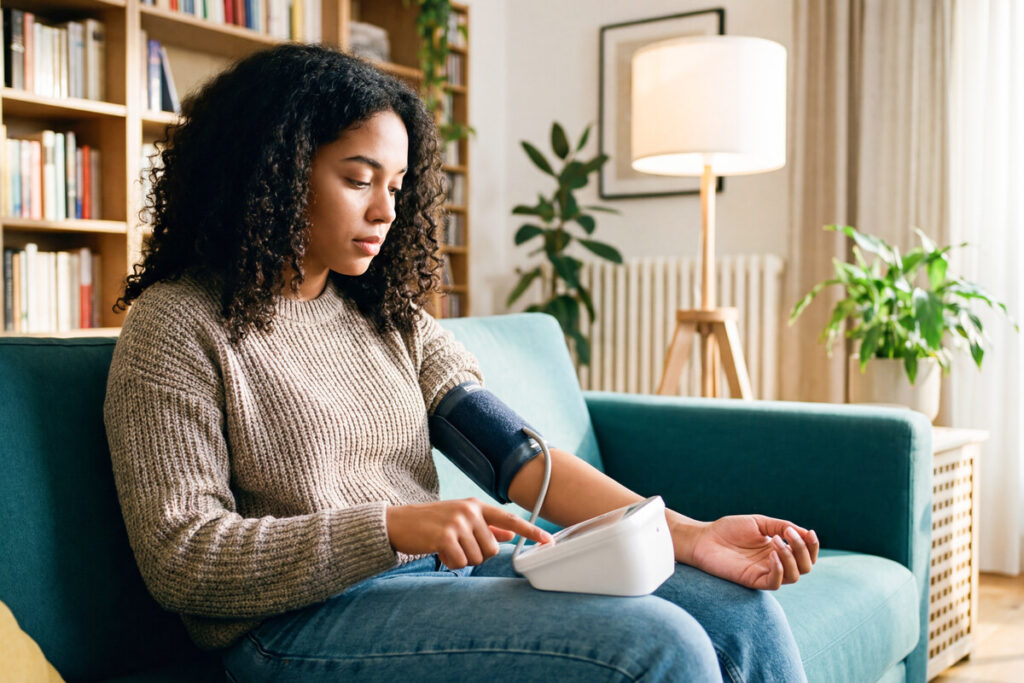
If your arm hangs at your side or rests in your lap while the cuff inflates, your blood pressure reading can come out several points higher than it really is. A randomized trial run by Johns Hopkins researchers measured exactly how much, and the gap is big enough to push a normal reading into the “high” range.
That matters more than it sounds for college students. Your blood pressure gets checked at the campus health center, at a sports physical, before you give blood, or on a machine at the pharmacy. Most of those checks are quick, and the researchers note that proper arm position is often overlooked in everyday practice.
What the trial actually tested
The study, called the ARMS crossover randomized clinical trial and published in JAMA Internal Medicine in 2024, enrolled 133 adults aged 18 to 80 in Baltimore. Each person had their blood pressure taken in three ways, in random order: arm supported on a desk with the middle of the cuff at heart level (the position guidelines recommend), hand resting on the lap, and arm hanging unsupported at the side.
Everything else followed the rules. Participants emptied their bladder, sat for five minutes with their back and feet supported, stayed off their phones and did not talk. Each position got three readings, averaged together. To check for natural ups and downs, everyone also had a second set taken with the arm on the desk.
How much higher the numbers came out
Compared with the desk position, a hand resting on the lap raised the top number (systolic) by 3.9 points on average and the bottom number (diastolic) by 4.0. With the arm hanging at the side, systolic readings came out 6.5 points higher and diastolic 4.4 points higher.
The authors point to a few likely reasons. A cuff that sits below heart level picks up extra pressure from gravity, and an arm with nothing to rest on keeps its muscles working, which can briefly raise blood pressure. Among people whose systolic pressure was already 130 or more, the side position overestimated it by about 9 points.
Using national survey data, the researchers estimated that poor arm position could lead about 22% of US adults to be wrongly classified as having hypertension when the 130 cutoff is used. They also note that some subgroups were small, and that the results may not apply the same way to every device or setting.
Why this is worth knowing in your twenties
High blood pressure is not only a problem for older adults. According to the CDC’s National Center for Health Statistics, 23.4% of US adults aged 18 to 39 had hypertension between August 2021 and August 2023 (a reading of 130/80 or above, or taking medication for it). Among young adults who had it, only 27.2% had ever been told so by a health professional.
So the goal is not to wave away a high number. It is to make sure the number is accurate, in both directions. Keep in mind that the trial’s participants were 57 years old on average, so it did not look specifically at college-age students.
How to sit for a reading you can trust
- Support your arm on a desk or table so the middle of the cuff is level with your heart. If you are perched on an exam table with your arm dangling, it is fine to ask for something to rest it on.
- Sit with your back supported, feet flat on the floor and legs uncrossed.
- Rest quietly for a few minutes first, and do not talk or scroll during the measurement.
- Use a cuff that fits your upper arm. Clinics have different sizes, so ask if it feels too tight or too loose.
- If a single reading looks high, ask whether it can be repeated once you are properly positioned.
One reading never makes a diagnosis on its own. If your numbers stay high, or you have questions about your own results, talk with a doctor or nurse at your campus health center. They can repeat the measurement correctly and tell you what, if anything, to do next.