

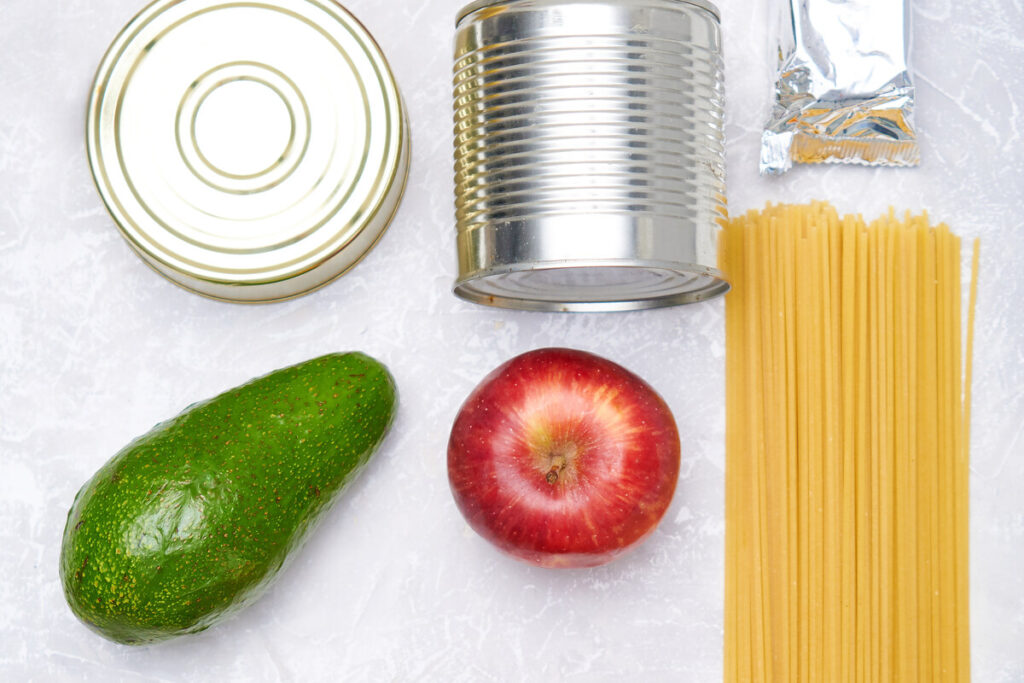
If your dorm fridge is tiny and your grocery budget is tighter, canned fruits and vegetables can look like a compromise. Research suggests the gap with fresh produce is smaller than most people assume, as long as you watch what is in the can besides the food.
Most students are short on produce to begin with
For someone eating about 2,000 calories a day, federal dietary guidance recommends roughly 2 cups of fruit and 2.5 cups of vegetables. According to the USDA Economic Research Service, the average American eats only about 0.9 cups of fruit and 1.4 cups of vegetables per day.
So the real question for many students is not “canned or fresh?” but “something or nothing?” Produce that sits in a cupboard for months without going bad removes one of the most common excuses: buying spinach on Sunday and throwing it out on Friday.
What canning does to nutrients
The most cited look at this question is a two-part review by food scientists at the University of California, Davis, published in 2007 in the Journal of the Science of Food and Agriculture. The authors compared the research on fresh, frozen and canned produce, and their findings are more nuanced than “fresh is always best.”
- The heat used in canning does reduce some water-soluble vitamins, such as vitamin C and several B vitamins.
- Once the can is sealed, those vitamins stay fairly stable during storage, because there is little oxygen inside.
- Fresh produce also loses nutrients during storage and cooking, and the review notes those losses may be bigger than people think.
- In the second part of the review, minerals and fiber were generally stable through processing, and carotenoids (the pigments in carrots, tomatoes and pumpkin) were often measured higher in canned products, partly because of how results were reported.
The authors concluded that recommending only fresh produce ignores the nutrient benefits of canned and frozen products. One detail worth knowing: the review was funded through the Canned Food Alliance, an industry group. Its conclusions are drawn from earlier published studies, but the funding is part of the picture.
Is canned actually cheaper?
Not automatically. The USDA Economic Research Service tracks the price of 155 fresh and processed fruit and vegetable products per edible cup. In its 2023 figures, the agency states that fresh products are not necessarily more or less expensive than processed ones.
Some examples from that data:
- Canned corn cost $0.68 per cup equivalent, compared with $1.42 for fresh corn.
- Canned green peas came in at $0.77 per cup equivalent.
- Fresh apples ($0.50) were cheaper than applesauce ($0.65).
- Canned cherries, at $4.28, were the most expensive fruit product in the whole dataset.
The takeaway: compare price per serving, not just the sticker on the can. Store brands and seasonal fresh produce can both win depending on the item.
The label matters more than the can
The main drawback of canned vegetables is added salt. A label claiming “low sodium” means 140 milligrams or less per serving under federal labeling rules, while “no salt added” only means no salt was added during processing, so check the Nutrition Facts panel either way.
If you already own a regular can, draining and rinsing helps. A study from the University of Tennessee tested five brands of five types of canned beans. Draining alone cut sodium by 36% on average, and draining and then rinsing cut it by 41%, from about 503 to 295 milligrams per half-cup serving.
For fruit, the thing to look for is syrup. Fruit packed in water or its own juice has far less added sugar than fruit in “heavy syrup.”
A simple shopping approach
- Keep a few cans of beans, tomatoes, corn or peas for weeks when you cannot get to the store.
- Pick “no salt added” or “low sodium” vegetables, and fruit in water or juice.
- Buy fresh produce you know you will eat within a few days.
- Use the unit price on the shelf tag to compare forms of the same food.
If you have a specific health condition, such as high blood pressure, a registered dietitian or your campus health center can help you decide how much sodium is right for you.