

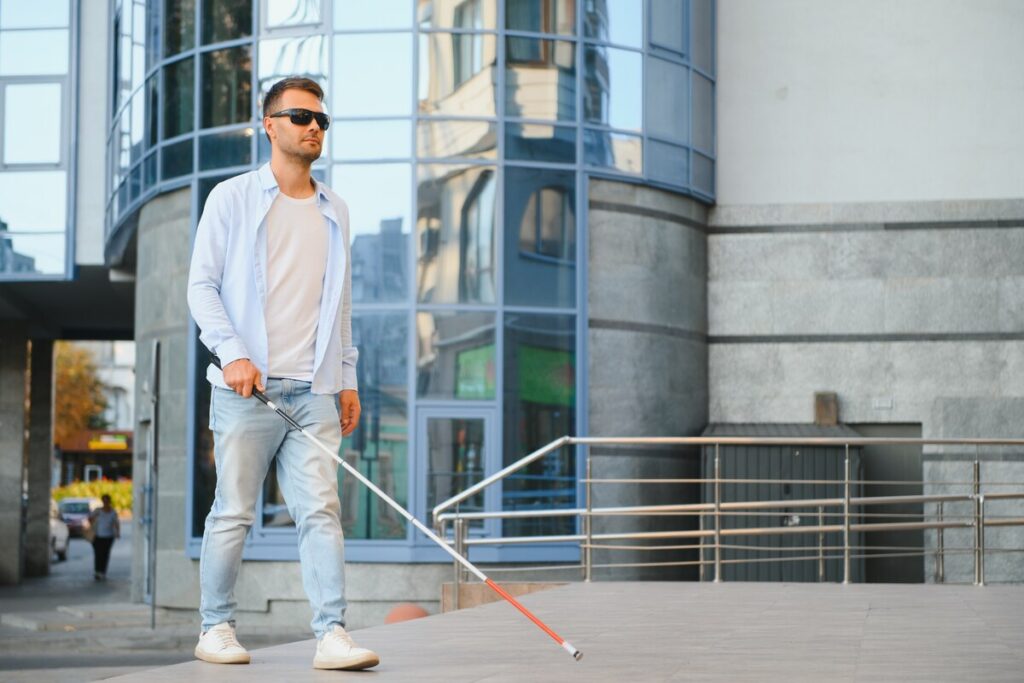
Bats and dolphins find their way by listening to echoes. A team at Durham University in the UK set out to see whether ordinary adults could pick up the same trick, and after 10 weeks of practice, both blind and sighted volunteers could use tongue clicks to judge objects and find their way around.
The research matters beyond a fun party skill. It adds to a growing body of evidence that the adult brain keeps reorganizing itself when you practice something hard, which is useful to know if you have ever assumed you are “too old” to pick up a new language, instrument or subject in college.
What the training looked like
Click-based echolocation works like this: you make a sharp click with your tongue, then listen to how the sound bounces back from walls, doors or objects nearby. A small number of blind people already use it every day, some of them since childhood.
In a 2021 study published in PLOS One, researchers trained 14 sighted adults and 12 adults who had been blind from birth, none of whom had echolocated before. Participants ranged in age from 21 to 79. They attended 20 sessions over 10 weeks, each lasting two to three hours, practicing tasks such as telling which of two objects was larger, judging how an object was angled and navigating virtual mazes, plus half an hour of real-world navigation per session.
Both groups improved considerably on every measure, and on some tasks a few participants performed comparably to expert echolocators by the end. Neither age nor blindness limited how much people improved from their first session to their last, and participants could apply the skill to new tasks they had not trained on. In a follow-up survey three months later, all of the blind participants reported better mobility, and 83% reported more independence and wellbeing.
What changed inside the brain
Members of the same team scanned the brains of the 26 volunteers before and after training. The results, published in 2024 in Cerebral Cortex, showed that the primary visual cortex (the area that usually handles the first stage of processing what the eyes see) became more active in response to echoes after training. That happened in sighted participants as well as blind ones.
The researchers described this as hard to reconcile with the idea that each sensory area of the brain is strictly reserved for one sense. They also found increased activity in the primary auditory cortex in response to sounds in general, along with increases in gray matter density in auditory areas. Those structural changes were not identical in the two groups, so the authors call for a more nuanced view rather than a single simple rule.
The key point: these changes showed up after 10 weeks of practice in adults, not just in people who had learned the skill as young children.
What this does and does not mean for students
It is tempting to turn a study like this into a motivational poster, but the details are worth keeping in mind:
- The samples were small. Twenty-six people is a modest group for a brain-imaging study, so the findings need to be repeated by other teams before anyone treats them as settled.
- The practice was intense and structured. Twenty sessions of two to three hours each, guided by researchers, is a lot more than a few minutes a day with an app.
- Gains stayed close to the trained skill. A separate 2021 paper in Experimental Brain Research found that the blind participants did not get better at a general sound localization task after training, even though their echolocation improved significantly. In other words, practicing one skill made people better at that skill, not at hearing in general.
That last point lines up with other research on learning: you tend to get better at what you actually practice. If you want to improve at organic chemistry problems or Spanish conversation, the most direct route is regular, effortful practice on those exact tasks, ideally spread over weeks rather than crammed into one night.
Could you learn to echolocate yourself?
The Durham team’s work suggests the basic skill is learnable by many adults, but the training in these studies was supervised and designed for safety, especially during real-world navigation. Its clearest practical value is for people losing their sight, for whom the authors see it as a possible rehabilitation tool. If you are curious, look for programs run by orientation and mobility specialists rather than trying to navigate blind on your own.
For everyone else, the takeaway is simpler. Your brain in college is not finished. With enough focused practice, adults in these studies picked up a skill most people assume belongs to bats.