

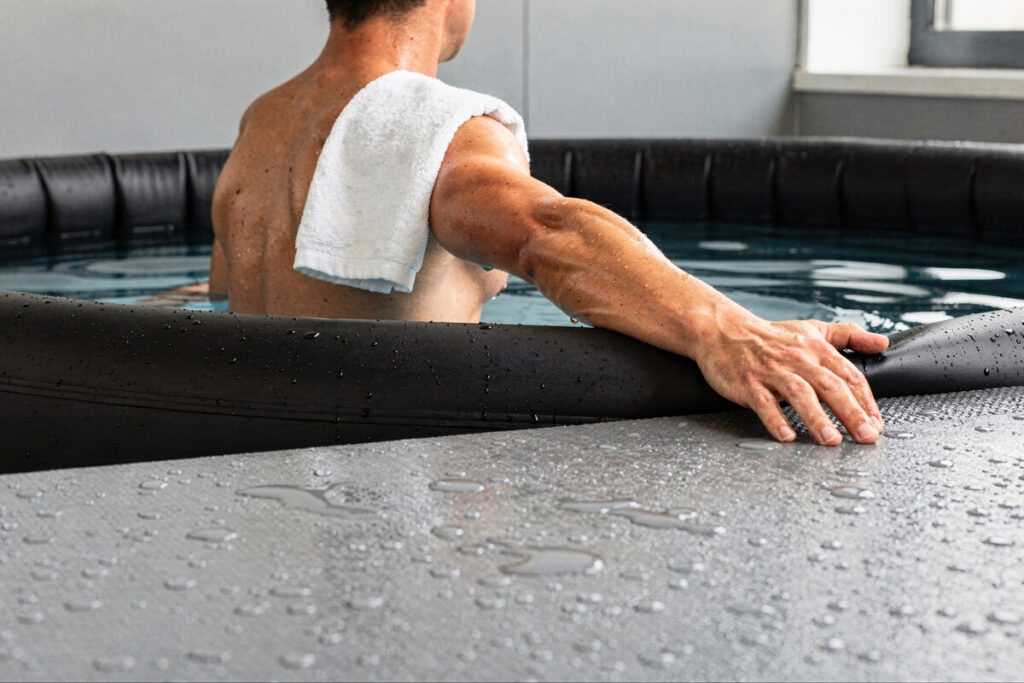
Cold plunges have become a popular recovery trend. A 2026 review of 15 meta-analyses covering 161 studies suggests they can ease soreness, but they are not a free upgrade for every workout.
Researchers at Edith Cowan University in Australia and colleagues pooled the findings of 15 published systematic reviews on post-exercise cold-water immersion (CWI). Their umbrella review in Sports Medicine – Open is the broadest look so far at what a dip in cold water does after exercise, and it comes with a clear caveat: the authors rated the quality of the underlying evidence as low to critically low.
What cold-water immersion seemed to do well
Across the reviews, cold-water immersion after exercise was linked to several short-term benefits:
- Less muscle soreness, for up to 96 hours after exercise.
- Lower blood levels of creatine kinase, a marker of muscle damage, between 24 and 72 hours afterward.
- Better heart rate variability right after exercise, a sign the body is settling back toward rest.
- Better muscle power and jump performance 24 to 48 hours after hard or eccentric (muscle-lengthening) exercise.
The protocols that looked most effective were fairly specific: about 10 to 15 minutes in water at roughly 10 to 15 °C (50 to 59 °F), or colder water at 5 to 10 °C for a similar stretch.
Where it fell short
The picture gets less rosy once strength training enters. The review found that cold-water immersion did not improve muscular strength and impaired strength and muscle-growth gains when used regularly after resistance training. Jump performance also dropped in the first hours after a dip, and endurance gains showed up only right away, with no later benefit on adaptation.
The authors summarized it this way: “Post-exercise CWI confers outcome-specific recovery benefits but may impair resistance training adaptations with chronic use.” They argue for a planned, case-by-case approach instead of an ice bath after every session.
What this could mean for students
Most students are not training for tournaments, so the findings are mainly a reminder not to treat cold plunges as automatic. A few takeaways drawn from the review:
- If your goal is building strength or muscle, a cold dip after every lifting session may work against you.
- If you have back-to-back hard sessions, such as a weekend tournament or intramural playoffs, the short-term benefits may matter more.
- Soreness relief is not the same as better fitness. Sleep, food and rest days are still doing most of the recovery work.
Limits to keep in mind
An umbrella review summarizes other reviews, so it inherits their weaknesses. The authors rated certainty of the evidence as low to very low, mostly because results were inconsistent and imprecise. The review covers healthy people in exercise studies, not students specifically. This is research on healthy people, not medical advice. If you have a heart condition, circulation problems or any health concern, check with your campus health center or a clinician before trying cold immersion.